 Search Properties
Buying Your Home
Let's start with your wish list.
From must-haves and deal breakers to location and schools. I can offer insight beyond photos to homes and neighborhoods — with comprehensive information on each new listing.
Preowned Listings I’ll weed through em’
- With access to the most up-to-date information, I quickly weed out unavailable properties and provide home listings that match your wish list and are available. See homes for sale.
Viewing Homes I’m ready when you are
- I book the viewing and send you any additional facts. I’ll be there to answer questions and talk over the details — while giving you space to imagine the possibilities.
New ConstructionFrom lots to floor plans
- My relationships with area new home builders means you get information on available lots, recently completed homes, and new developments including floor plans and options. Read more
Takena Estates, a new home devlopment in Albany, Sold Out!
See plat and floor plans
Walking through the process... so you’re ready when we find the right home.
I'll provide you with information on homes and neighborhoods, and walk you through the home buying process. With over 30 years experience in real estate and negotiating, I'll use my knowledge to help ensure your home buying experience is successful.
And best of all, there's no cost or obligation.
Interested in purchasing new construction?
My relationships with area new home builders means you get information on available lots,
recently completed homes, and new developments including floor plans and options. Read more
Takena Estates, a new home development in Albany, Sold Out! See plat and floor plans
Home Buying Process
- Discuss your Wish List
- Determine how much you can afford
- Assist in pre-qualification
- Narrow down available listings, that match your wish list
- Show you the homes, and answer any questions
- When you’ve found the one, I'll go to work to negotiate a fair offer.
- I'll work with you through the remaining steps including a home inspection, insurance, and closing.
Process for New Construction
- Discuss your Wish List
- Determine Price Range
- Preview Floor Plan and Communities
- Discuss Homes and Lots Available
- Discuss Standard Features and Options Available
- Discuss Sales Prices
- Discuss Allowances and Upgrades
- Calculate Sales Price of Your Selected Home
- Discuss Lenders and Loan Process
- Discuss the Construction Process & Time Frame
- Fill out your Sale/Earnest Money Agreement
Questions? Give me a call at 503-510-5038 or email. There’s no obligation.
Buying a Home
Answers to Common Questions
What does a Real Estate Agent do for you?
Answer: Almost everything.
A real estate agent is your most valuable asset when buying a home. They walk you through every part of the home buying process. They will educate and inform you of all your options. They will represent you throughout the transaction and beyond.
What’s the first step of the home buying process?
Answer: The Mortgage Pre-Approval.
Unless you are paying cash for a house, you will need to get a mortgage. In order to know how much home you can afford, you will need to get pre-approved for a loan. This is the first-step in the home buying process.
If you don’t already have a mortgage broker you are working with, just let me know and I can connect you with one of the many I work with. Get pre-approval before your search for property. Due to the low inventory, it’s necessary to submit a pre-approval letter with an offer, and without it, you can possibly lose out on a sale.
What happens when we find the home?
Answer: We sit down and work out the details of an offer. Once we’ve determined what you want to include in your offer, I will fill out all the appropriate the paperwork. I review all the forms with you and gather all the necessary signatures. At this time we will ask your mortgage broker for a pre-approval letter specific to the home we’ve identified. I will forward the offer to the listing agent and advocate for you through to final acceptance. Once we’ve reached mutual acceptance, I will continue to see the process through, step by step until closing.
Do I select properties to tour or do you?
Answer: Both!
I regularly search the local listings in our area and will send you information on any and all homes that fit your needs.
I also, encourage you to use the home home finder search tool on my website. The information is pulled from the database we (local real estate agents) use. All the information is maintained and monitored by the Willamette Valley MLS and is the most accurate information available.
If you are using other websites like Trulia, Realtor.com, Zillow and others, please verify the accuracy of the information by utilizing my search tool or by messaging me personally.
How will you keep me informed about the progress of my transaction?
Answer: You tell me!
Just let me know how often you’d like updates and your preferred method of communication. I will keep you up to date as often as you’d like.
How long does it take to buy a Home?
Answer: Around 45-60 days
The timeline for finding a house varies greatly from person to person. Once you find a house and have an accepted offer, it usually takes around 45-60 days to close.
What the does the NAR (National Association of Realtors) Settlement Change for homebuyers?
Answer: The National Association of Realtors (NAR) settlement changes how buyer‑agent compensation is communicated, not whether agents can be paid.
- Commissions are still negotiable between clients and their agents.
- Sellers can still offer compensation to buyer agents, but those offers will no longer be displayed on the MLS.
- Buyers will now sign a written buyer‑broker agreement before touring homes, outlining how their agent will be paid.
How Payment Works Under the New Rules
- The seller can still choose to pay both sides of the commission as part of the listing agreement.
- If the seller does not offer compensation, the buyer and their agent decide together how the buyer’s agent will be paid—sometimes through seller concessions, sometimes directly by the buyer, sometimes through a negotiated arrangement in the offer.
- All compensation must be transparent, agreed to in writing, and negotiated upfront.
What This Means for Buyers and Sellers
- Buyers get clearer expectations and written agreements about representation and cost.
- Sellers still have the option to attract more buyers by offering compensation—but it’s no longer advertised on the MLS.
- Agents must clearly explain their value and compensation structure before showing homes.
What Kind of credit score do I need to buy a home?
Answer: A 620 credit score, or higher, is recommended. As you are probably aware, a higher credit score offers better lending terms. This is an ever evolving topic, however, as loan requirements are constantly changing. There are some lenders who will approve buyers with a 580 score, sometimes even lower. Your loan officer will be the best source to give you a current answer for today’s lending requirements.
Are there special home buying programs that I should know about?
Answer: Yes, there are some great home buying programs to research. The main ones would be VA loans, USDA loans, and FHA loans. I work with several great Mortgage Brokers/Loan Officers. I’m happy to partner you with one that is the perfect fit for you. They will inform you of all the great programs available and pair you with the loan that best fits your needs.
How much money do I need for a down payment?
Answer: It depends on your loan type. Usually 3% to 5% down.
The most common answer is 3% to 5% of the purchase price. FHA loans just dropped their requirement from 3.5% to 3.0%. There are also some conventional loans that only require 3% down. Veterans are usually eligible for a VA loan, which requires no money down. Properties in rural areas are usually eligible for a USDA loan, which also requires no money down.
What other fees are there, besides the down payment?
Answer: Mainly loan origination and closing costs.
The down payment is usually the largest cost associated with buying a house. Lending fees are the second largest costs to homebuyers. Most lenders will charge between 2% to 4% of the loan amount for loan origination fees, depending on the loan type. Conventional loans usually have lower loan origination fees, but require more money down. Your loan officer will be able to help you determine how much you can expect to pay towards loan origination and closing costs.
Relocating? I’ll be your scout
Who needs surprises? I’ll preview locations for you, finding the best properties that fulfill your needs. That way, when you see a home it’s everything you hoped for.
I can also make some recommendations. Living here all my life I’ve gotten to know the area, neighborhoods and amenities.
This past summer my wife and I contacted Lacey from our residence in Amarillo, Texas, and asked her if she would be willing to find some houses for us to look at in the Willamette Valley. A few days later, literally, we showed up and spent an entire day with Lacey. Without ever having met us and with only a brief telephone conversation, Lacey had set up appointments to visit something like 10 homes, in which one of them we are now happily living. We recommend Lacey Stark most highly.
– Jim R
Ready to Get Started ...
Let's schedule time to talk.
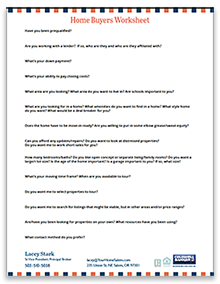
I can also email you our Home Buyers Worksheet, to help you get started.